The Coffee Guru.
Built because most coffee reviews come from a few days with one machine.
An independent site that reviews and compares coffee and coffee gear. 484 products across 21 categories, each scored on the specs the maker or roaster publishes, with the reasons for every score shown on the page.
- Role
- Founder
- Live site
- thecoffeeguru.net ↗
- Catalogue
- 484 products 21 categories
- Started
- 2018
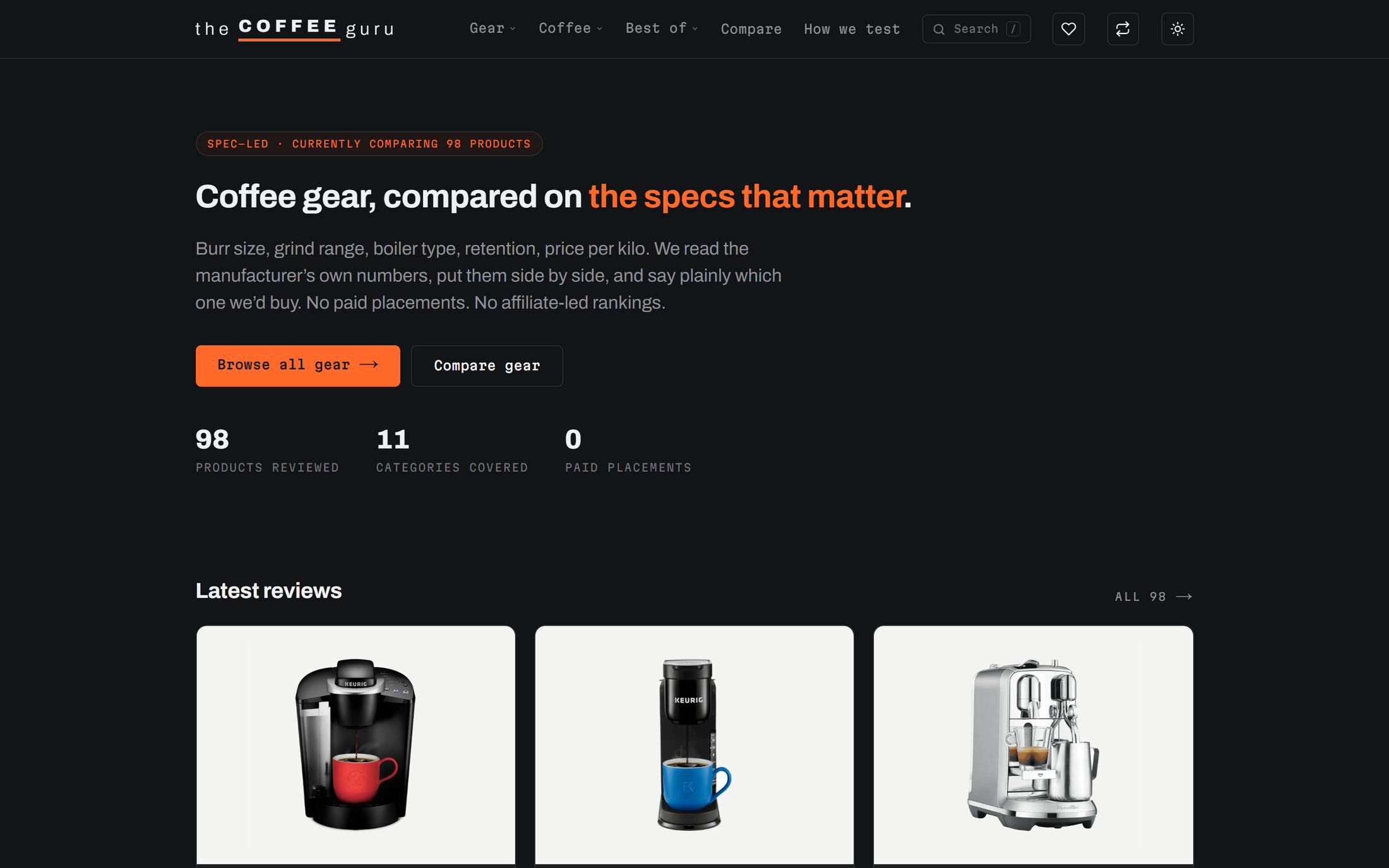
The Coffee Guru · homeFig. 01
Most coffee equipment reviews come from a few days with one machine. They say how it was to unbox and use that week, and they rarely set it against the alternatives on the details that actually separate them.
Those details are mostly published already: burr size and grind range for a grinder, boiler type and temperature control for an espresso machine, price per kilo for beans, price per cup for pods. The maker or roaster lists them, but they sit scattered across product pages and manuals and seldom end up in one place.
The Coffee Guru collects them and puts them side by side, scored the same way every time, across 21 categories, from grinders, espresso machines and kettles to beans, pods and the roasters who sell them.
Every score shows its working.
Each score breaks down into parts, and you can open each one to see what it was based on. If the published information is thin, the page says so instead of guessing.
If something can’t be judged from the specs, it’s left out of the score, not counted as zero. A product never loses points just because information is missing.
Every comparison picks one.
Lists are ranked by score. Every comparison ends with a clear pick and says who should skip each product, which is often the most useful part. It’s written for someone about to buy, stuck between two grinders, who wants to know what really sets them apart.
Built for phones.
Every page works on a phone, including comparison. You can compare up to five products side by side on any screen.
There’s a light and a dark mode, switched from the header. Figure 01 shows dark mode on a desktop, figure 02 shows light mode on a phone.
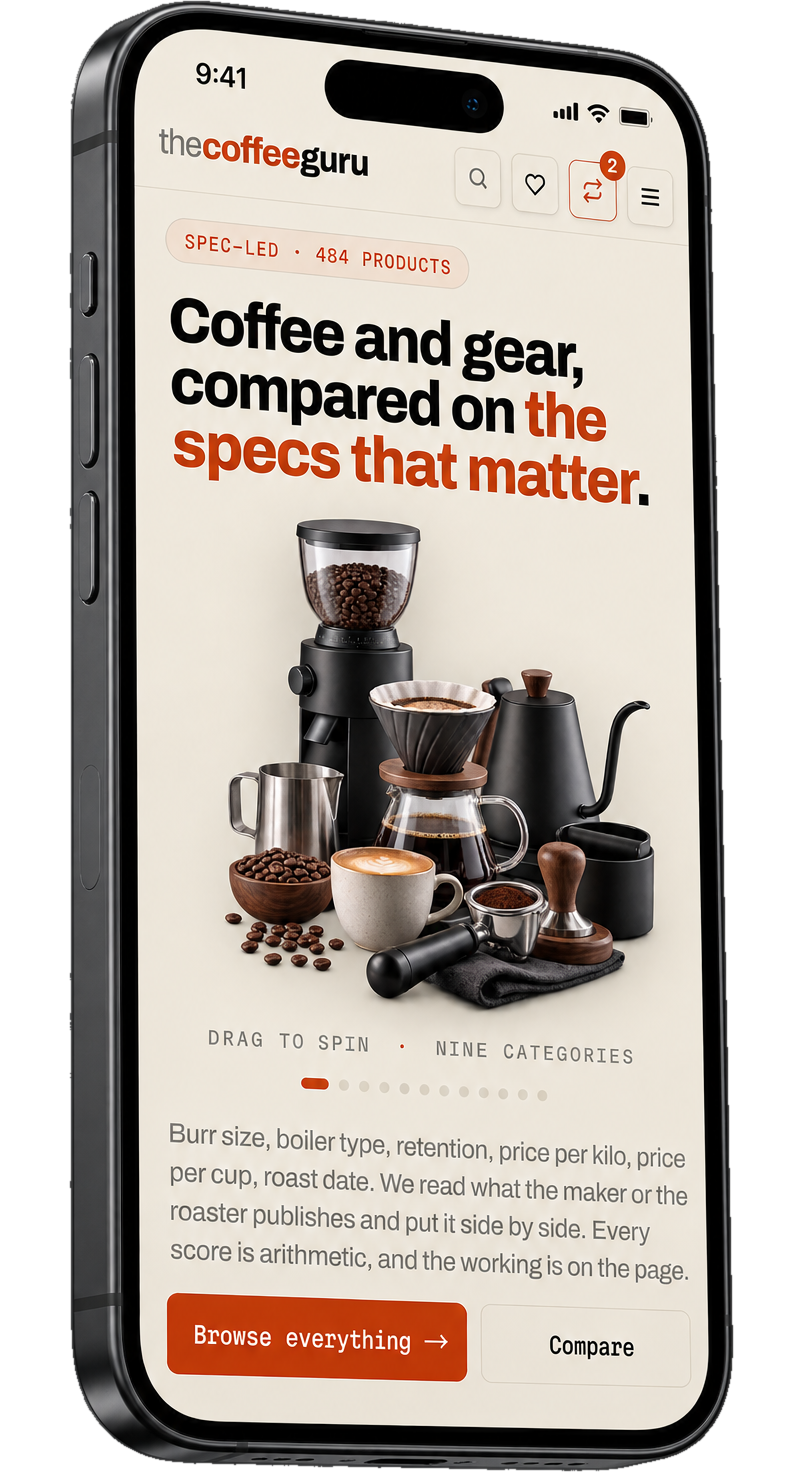
The Coffee Guru on a phoneFig. 02
Gear
Grinders, espresso, bean-to-cup
Drip, pour over, French press
Moka, kettles, scales
Reviews
One product per page
Scored from published specs
Each part of the score opens up
Comparison
Up to five products
Same rows, same order
Ends with a clear pick
Coffee
Beans, pods and instant
Roasters and subscriptions
Kept separate from gear
Buying guides sit above both, sorted by category, by price and by use.